

I recently explained our mental system with my new mental model and introduced the process of endless-loop thoughts in the previous article (this one).
Let’s take a closer look at that process with more detailed diagrams.
What is the true cause?
Sometimes, we want to logically understand our mental confusion, which causes various inner struggles, such as unstoppable worries, endless-loop thoughts, emotional exhaustion, frequent flashbacks, loss of boundaries between self and others, and destructive impulses.
Although we know that something within us is wrong, we don’t know exactly what the cause is, especially when our thoughts are infinitely cyclically recurring. Everything appears doubtful.

That is why we want to understand our mental processes to stop endless loop thoughts.
In my opinion, mental confusion stems from failing in the evaluation stage during the decision-making process. Today, I will explain it with my new mental model. This logic may show you why cultivating rationality resolves mental problems.
The mental model
Our inability to properly evaluate things prevents us from making decisions. In other words, gaining the core of our thinking ability resolves our mental confusion.
To make it easier to understand, let’s explain it with my new mental model.
In my model, there are four elements: consciousness, the memory area, the primitive cognition area (the subconscious), and the body, as shown in the following figure.
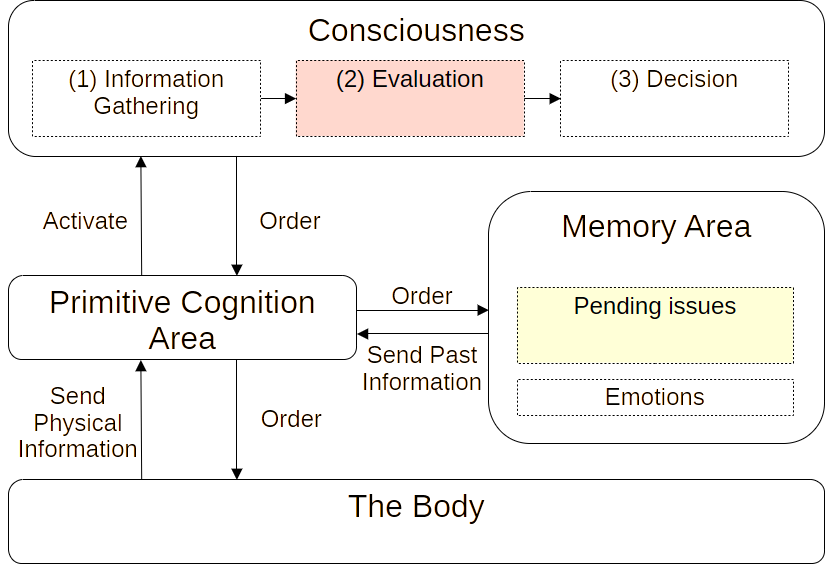
(By the way, I changed the process name ‘Evaluation’ in Consciousness from ‘Analysis.’)
The judgment flow
Those elements divide roles and make intelligent decisions.
For example, let’s say we felt hungry. In this case, it is processed in the flow shown in the following diagram:
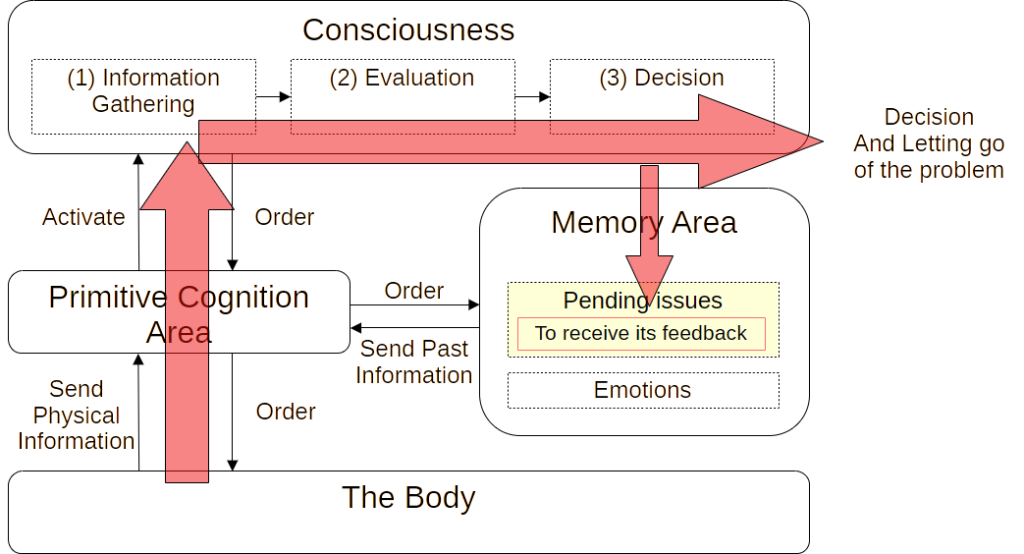
First, the primitive cognition area detects the physical stress from the body. Then, if the primitive cognition area judges that it requires an intellectual response, it activates consciousness and prompts a decision.
Consciousness gathers situational information and memory as needed. We recognize that we are hungry and are engaging in a business meeting, which will end in 30 minutes, but a snack is in the bag. Then, we evaluate them and make a reasonable decision: we will wait 30 minutes and go to the cafeteria.
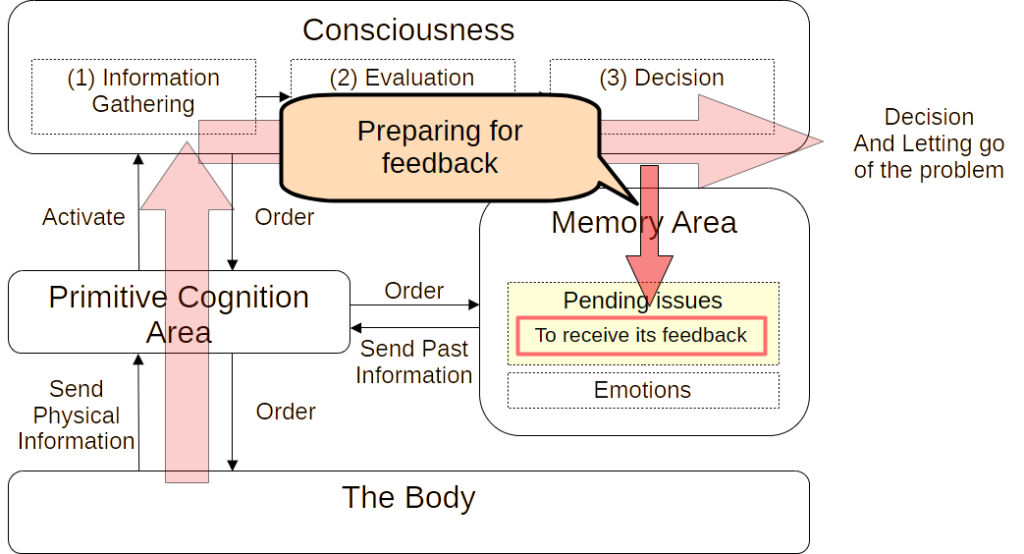
To receive feedback on this decision, we store a reminder in the pending area of our memory to alert us after 30 minutes. Then, we return our focus to work. In other words, we resolved the matter of hunger and let go of it.
That is the flow of one decision, although there is still a pending issue.
Processing the pending issue
Receiving feedback is also carried out as a flow of decision-making, as shown in the following diagram:
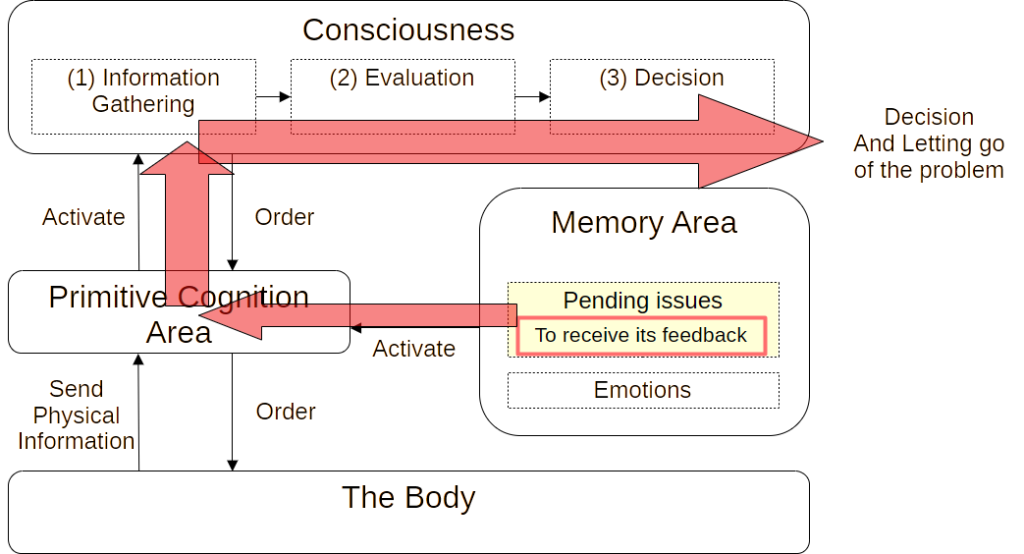
About 30 minutes later, the memory area requires an intellectual decision. The primitive cognitive area detects that almost 30 minutes have passed, and consciousness is reactivated. Then, we recognize the situation again. Once the meeting ends as expected, we will willingly head to the cafeteria as planned.
Having finished one set of intellectual decisions, we let go of the problem. If necessary, we store the successful experience and its causality in the memory area.
Even if things don’t go as expected, we continuously receive feedback that provides us with the correct causal relationship. The accumulation of feedback gives us learning and eventually leads us to a reasonable approach. In other words, we never repeat the same problem. That is intellectual learning that consciousness is naturally skilled in.
The flow of loop thoughts
However, a lack of evaluative ability prevents us from making decisions.
Some factors hinder our judgment. A typical example is irrationality, which forces us to use faulty reasoning.
For example, we may connect the current problem to our incompetence. Although oversleeping and skipping breakfast have nothing to do with self-worth, we assume our lack of ability is the cause. Since there is no answer to the question of whether we are incompetent, we cannot make a judgment (until we become aware of the unreasonableness and stop linking them in our thinking). We feel discouraged about our inability.
When we cannot decide, we push the problem itself into ‘the pending issues’ of the memory area, postpone the decision, and try to forget it, as shown in the following image. This process is called mental suppression.
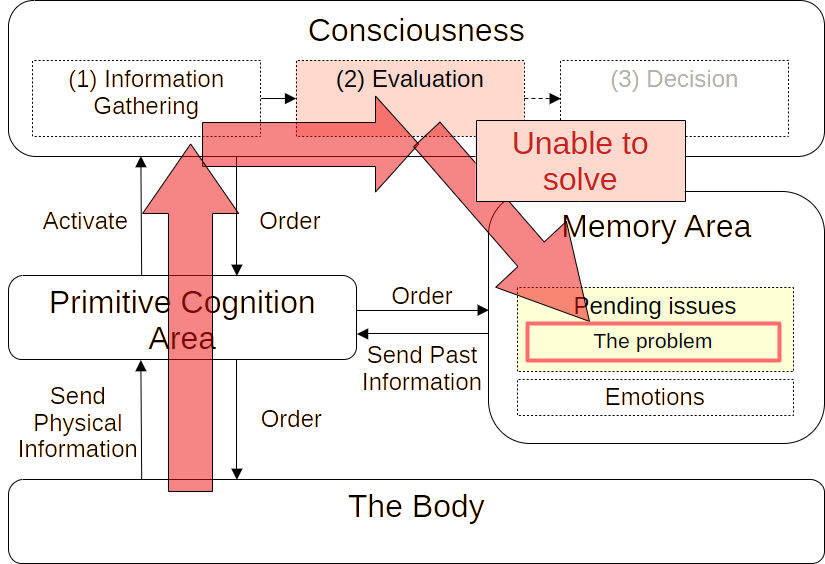
Since it is a pending issue, it resurfaces in consciousness after a certain period of time, when something triggers the memory, or when we relax.
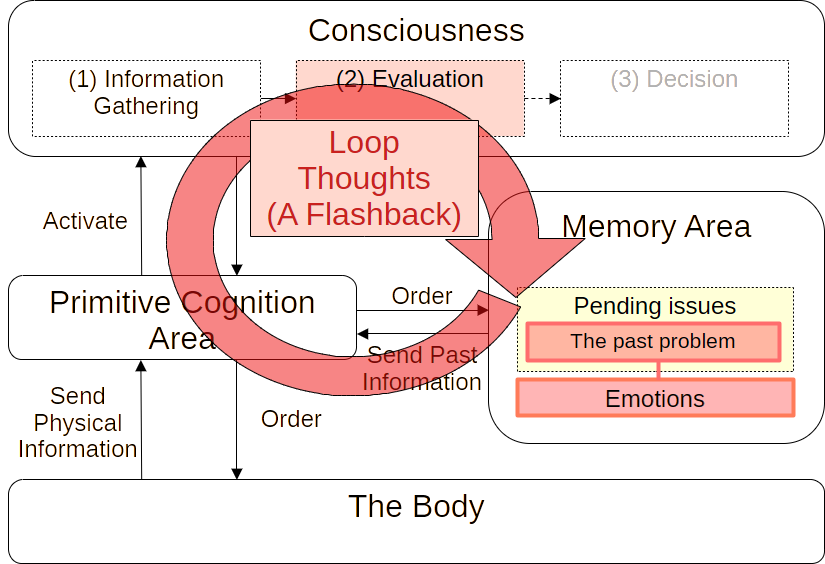
When the problem (the past event) resurfaces in consciousness again, we gather information that is relevant to the events, including the emotions we felt previously. That causes us to reexperience those past feelings. We feel the negative, discouraging emotions again.
Since we still lack the evaluative ability, we cannot decide our response and repress the problem continuously. That is the process of loop thoughts: it makes us replay unresolved past matters repetitively.
It shows us that the process of unstoppable worries is the same as that of flashbacks. Both repeat the same problem, accompanied by strong emotions.
That event stirs our emotions repeatedly. It is as if there is another personality, which can be called the ‘inner child,’ inside us. We lose our own values and boundaries between ourselves and others. We sometimes try to become competent to deny that negative feeling but sometimes start to hate everything and become destructive. Repeating the same problem causes those emotional symptoms.
Resolving it from now on
That process shows us how to resolve the mental problem: reviewing the evaluation process in consciousness. In other words, we need to cultivate rationality so that we can recognize the unreasonable factors in our decision process.
Since all past events are issues whose decision has been postponed, we can decide from now on. It is not a past problem but a current, ongoing one.

Since past pending issues resurface sooner or later, we should focus on the current rational judgment.
That is why there is no point in exploring the subconscious. It is a matter of consciousness, not the subconscious or past events. We have to identify the unreasonableness that hinders our decision.
Conclusion
That is how our mind works.
In my opinion, mental confusion stems from failing in the evaluation stage during the decision-making process.
That is why there is no point in exploring the subconscious.
This logic may show you why cultivating rationality resolves mental problems.
Let’s look at the process of acquiring irrational reasoning in the following article.
Thank you for reading this article. I hope to see you in the next one.