

Last week, I introduced my new mental model to make it easier to understand how our minds work. Today, let’s look at the process behind repetitive thoughts.
By the way, I added a new category for this mental model (Category: Mental Model). Please use that link to find related past articles.
How does our consciousness process?
Sometimes, we want to handle our minds more efficiently. Although it is our mind, there may be things we cannot control, such as unstoppable worries, endless-loop thoughts, and emotional exhaustion.
Understanding the mental process enables us to solve it.

However, there has not been an effective mental model. That made it difficult to understand our minds.
My new mental model can explain it effectively. Today, let’s look at the overall process of repetitive loop thoughts with the model. That shows us the approach to solving mental problems I am proposing.
The four elements of the mind
Rational thinking solves the unstoppable loop of thoughts. It means we don’t have to force ourselves to uncover subconscious and past painful memories. Being able to make current judgments gradually solves all past problems.
To explain why, let’s look at my new mental model shown below.
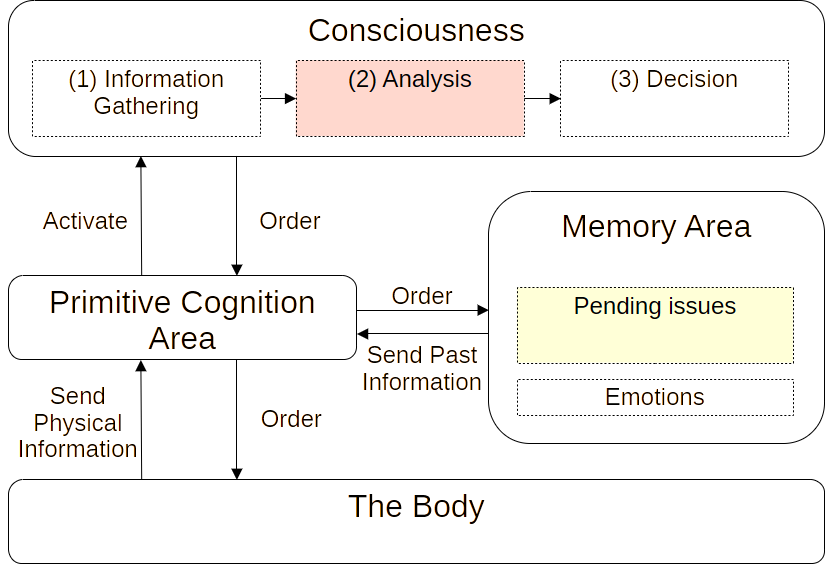
In my model, there are four elements, as follows:
- Consciousness functions to think and make decisions. When activated, it produces the sense of self. After a decision, it deactivates and enters a meditative state.
- The memory area provides knowledge, past subjective experiences, and the emotions associated with them.
- The primitive cognition area (the subconscious) connects the conscious to the other parts. It activates consciousness and prompts it to decide according to the needs of the body or the memory.
- The body detects information, including physical, visual, and linguistic, and sends it to the primitive cognition area. Even if consciousness is deactivated, the body continues to work.
The role of consciousness is to make decisions, which the body or the primitive cognition area cannot execute. In other words, our consciousness exists just for intellectual judgment.
The work of consciousness and the memory area
Let’s look at how our consciousness works.
Once we decide, we act, let go of the problem, receive feedback, and move on to the next issue.
For example, when the body feels hungry, that information goes to the primitive cognition area. If the primitive cognition area requires intelligence, it activates consciousness, sends relevant information, and prompts a response.
That creates self-awareness and thoughts.
Consciousness
In the conscious process, we think in the following three steps:

- Information gathering: We recognize the situation by obtaining the necessary information from our surroundings and memory.
- Analysis: We identify the causes, the goal, and the possible measures, including those of benefit and cost.
- Decision: We choose the most reasonable option and take action. Decision means letting go of the problem. If the result is unknown and feedback is needed, we put a reminder to check the feedback into ‘the pending issues’ in the memory area.
The memory area
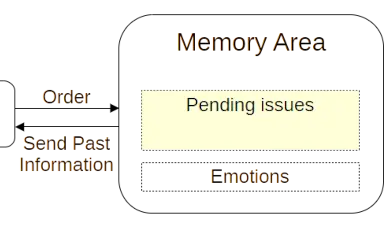
In the memory area, there is a function called ‘pending issues’ as a reminder of things we care about, surfacing them after a set time or when we are relaxed.
The judging process
Let’s introduce how our minds work with an example.
Suppose we felt hunger suddenly. When consciousness is activated, we first try to gather information and recognize the situation—for instance, we are in a business meeting but feel hungry.
Then, we analyze the cause, the goal, and the measures. We remember that we overslept and skipped breakfast, which caused this problem. The meeting will end in 30 minutes. There are snacks in the bag, but the meeting is formal and important.

Finally, we make decisions: to wait until the end of the meeting. That let us let go of the problem and set a reminder in the memory area: ‘I will go to the cafeteria right after the meeting ends.’
The decision frees us from the problem. Even if we are still hungry, its pain eases, and we can focus on work. The primitive cognition area follows our decision unless an unexpected or serious physical problem occurs.
Then, about 30 minutes later, or when relaxed, we remember the hunger again.
Those are the processes in decision-making.
Analytical failure
However, failure to analyze prevents making decisions. That causes endless loop thoughts with recurring ones whenever we are relaxed.
Its main factor is unreasonableness, which confuses logical causality.
For example, we may connect skipping breakfast to our incompetence. We blame ourselves: ‘Why did I make such a mistake?’

It is an irrational accusation because it is something we have decided. The hunger should be received as feedback on the morning’s decision of skipping breakfast. Being aware of that enables us to learn from the experience, decide to eat even a little next time, accept the causality, and let go of the matter.
However, trying to seek another result in feedback doesn’t make sense. It is impossible because feedback is already the result. In other words, one’s incompetence is another matter. Linking them is unreasonable.
That failure of logical analysis prevents decisions. That causes endless loop thoughts due to the inability to make judgments.
That is not a matter of the past but of the current analysis.
Let’s look at the process of analysis more deeply in the following article.
Conclusion
That is the overall process of repetitive loop thoughts.
The failure of logical analysis prevents decisions. That is not a matter of the past but of the current analysis. That causes endless loop thoughts.
That eventually leads us to why rational thinking solves those problems.
In the following articles, let’s take a closer look at the analysis process.
Thank you for reading this article. I hope to see you in the next one.