

In the previous article (this one), I introduced my new mental model, which makes it easier to understand how our minds work and resolve our spiritual problems. Today, let’s look at the role of the conscious.
What is a comfortable mental state?
Sometimes, we want a comfortable mental state. It calms our minds and fulfills us mentally.
However, we don’t know what a stable mind is. Our desires always shift.
For example, we know that the pleasure of an accomplishment will not last long. We sometimes desire excitement, but sometimes it switches to relaxation. Although we enjoy a meditative state, which empties our minds, we cannot maintain it without interruption.

In other words, our mental states always shift. Then, what is a comfortable mental state?
The role of consciousness shows us the answer: to make decisions and then deactivate itself. That tells us that a smooth shift is a healthy, stable mental state. Today, I will explain it with my new mental model.
Two states of consciousness
The role of consciousness is to make decisions. Once a choice is made, it is deactivated and enters a meditative state. Being able to do it smoothly is a healthy, stable mental state.
Consciousness has two states, as follows:
- An activated state: we focus on thinking to make a decision. We can be aware of ourselves.
- A deactivated state: we are in a meditative state. We are not aware of ourselves, but we are comfortable in terms of mental conflict.
Both states are comfortable when their processes go smoothly. However, we sometimes cannot stop activated states. That causes mental exhaustion and spiritual problems, such as unstoppable worries and emotional disturbance.
The four mental functions
To make it easier to understand, let’s explain it with my new mental model, which is shown in the following figure:
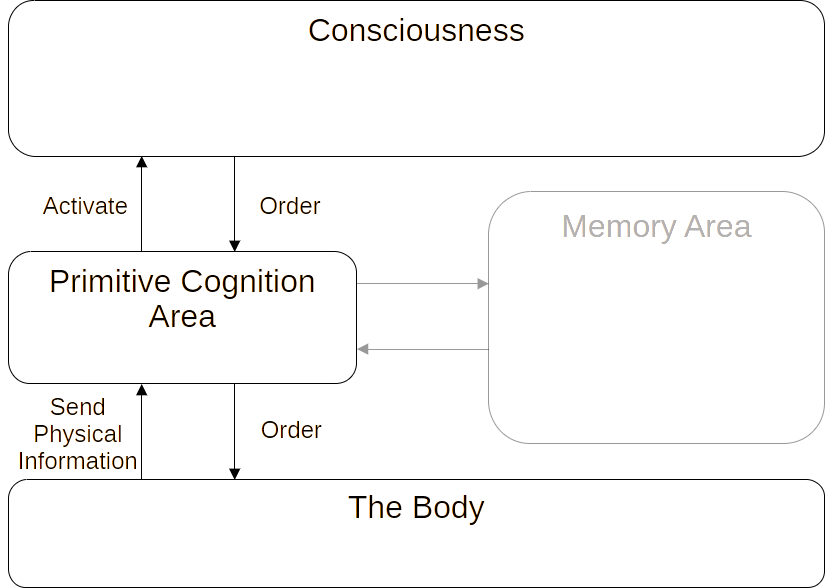
In my model, there are four mental functions, as follows:
- The consciousness functions to think and make decisions. When activated, it produces the sense of self. After a decision, it deactivates.
- (Not in use in this article) The memory area provides past subjective experiences and the emotions associated with them.
- The primitive cognition area (the subconscious) connects the conscious with the other parts. It activates the conscious and prompts to decide according to the needs of the body and the memory.
- The body is the physical part. Even if the conscious is deactivated, it continues to work.
How our consciousness activates
When there is an issue in our body or memory, it activates the conscious through the primitive cognition area.
For example, let’s say we are sleeping on the bed. In this state, the conscious is deactivated, so we cannot be aware of ourselves. However, the body continues to work with the purpose of rest.
When the body has had enough rest or has another issue, the primitive cognition area detects it and activates the conscious, sending the information that ‘the body seems hungry’ and prompting the next action.
That makes us self-aware and lets us decide to get up and prepare breakfast. When we are used to it, the conscious becomes less active and proceeds with cooking with only minimal judgment.

That is the meditative state, which doesn’t particularly require any decisions. In this state, we engage in an activity to satisfy a specific want, such as hunger, exercise, creation, or moving to another place, without being aware of ourselves.
In this state, the body controls stress according to expectations. While preparing breakfast, despite increasing our hunger, it doesn’t mentally stress us unless it exceeds our expectations. The primitive cognitive area manages it. In other words, anticipated stress doesn’t disturb the mind.
On the other hand, unexpected stress awakens our minds. Suppose a trouble occurred after breakfast: the news said that the commuter train is not running due to the strike. The primitive cognition area activates the consciousness again and urges us to make judgments.
We try to gather information, compare the options, and decide. Then, once things begin to proceed as planned and physical stress is released—through crying, sighing, or laughing—the conscious deactivates again.
The healthy mental state
Although I removed the factor of our memories, that shows us the fundamental mental comfort: being able to shift those activations and deactivations smoothly is a healthy, stable mental state.
There is no point in forcing yourself to stay conscious or sustain a meditative state. Natural shift matters.
In a healthy state of mind, one can make decisions, even if the information is not enough. We can expect the worst risk of death, even if it materializes, so we can accept it with a calm mind.

In other words, risk doesn’t cause mental struggle; the inability to make judgments does. The mismatch between expectation and reality creates mental exhaustion.
It is a matter of the conscious, not the subconscious. We should focus on the processes of consciousness rather than the work of the primitive cognition area to resolve spiritual problems.
Although we eliminated the factor of memory in this article, it is just a piece of referential information. There is no point in exploring the subconscious, in my opinion.
Conclusion
That is why being able to decide smoothly is a healthy, stable mental state.
Both states are comfortable if their processes go smoothly.
The mismatch of expectation and reality creates mental exhaustion. That is a matter of consciousness.
This understanding will lead us to solve our mental problems. I will explain in more detail in later articles.
Thank you for reading this article. I hope to see you in the next one.