

Recently, I have explained the new sense I developed this year. Rationality provides us with another sense that shows new opportunities. Let’s add more explanation.
How to find courage
Sometimes, we want the courage to challenge new things.
We fear loss. We believe that it will worsen our lives. On the other hand, we expect that the benefit will enrich our lives. We assume we must eliminate loss and maximize profit.
Under such limitations, we prioritize changing our lives. That makes us want the courage to act.

However, my attitude toward courage has changed this year. I realized we don’t need courage to change our lives.
Rationality shows us reasonable opportunities that are insensitive to empathy. Today, I will introduce a perspective on how I came to identify opportunities I had not noticed before. They didn’t require courage or confidence. This perspective might help you improve your life more effortlessly and lightly.
Two types of decision-making styles
My point is simple: if you are empathic and logical, try to judge your emotions as rationally as possible. Rationality eliminates the necessity of courage. It reveals opportunities that we cannot see when we judge things in black and white.
If we are empathic and logical, there are two types of decision-making styles, as follows:
- Pursuing clarity and making everything black and white: We use this style when we rely solely on empathic judgment. A clear answer reassures us and enriches us. However, we cannot apply this style in fields where there are no right answers, such as happiness and life.
- Judging reasonably amidst chaos: We apply this style when we start to use rationality and empathy simultaneously. Although we lose clear answers in our lives, we can identify reasonable, moderate opportunities that we have missed.

They can be described as our eyes. The former is seeing the world with only one eye. Although we can see clearly, we cannot sense distance. On the other hand, the latter is watching things with two eyes. Although it blurs elements that are out of focus, it shows us a proper distance for the objects we focus on.
Using both eyes reduces our stress in life. Although it takes clear answers out of our vision, continuously changing our focus enables us to live reasonably while balancing our lives.
The metaphor of gatekeepers in Buddhism
Rationality reveals opportunities we have overlooked.
To make it easier to understand, let’s introduce a metaphor of gatekeepers in Buddhism.
At some Buddhist temples, there are two guardian statues at the gate. Despite their muscular figures with terrifying, enraged expressions, they are the symbols that protect those temples from evil.
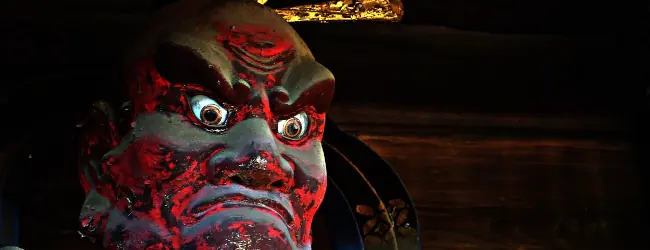
Each of them is holding up one hand as if to say, ‘Stop!’ and intimidating the visitors to the temple. However, with their other hand, they are gently gesturing, ‘Please, come in.’
If we see things in black and white, they appear clearly hostile toward us. Our emotions will say not to enter the temple.
Their inconsistent attitudes
However, from a rational perspective, there is an inconsistency: why does one of their hands gently gesture to invite entry?
We can infer the reason from that inconsistency. It is pointless for them to prevent anyone from entering the temple. If they banish everyone, even the monks of the temple cannot re-enter once they leave.
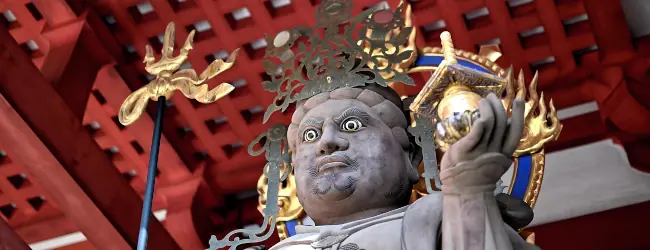
Those gatekeepers intend to invite only calm people while driving away those who are malicious with an inferiority complex. Their contradictory attitude prevents those who judge only in black and white from entering. On the other hand, logical people can guess their roles rationally. That reassures us and enables us to try to enter the temple.
Such symbols are all over the world. They often teach, ‘Don’t be afraid.’ In The NeverEnding Story, the protagonist must pass the two sphinx-like gatekeepers at the place called South Oracle. Those sphinxes destroy anyone who enters with fear, even if slightly. It means we need to believe in our rationality.
They are symbols of testing rational judgment. Only logical people can enter.
Identifying new opportunities
That shows us how we can identify new opportunities that many people cannot see.
We can discover contradictions in things that we once saw as purely black, such as enemies, danger, and fear. Although it appears negative, something feels off. It is like the gatekeeping statues at temples. They are doing something unnecessary if we assume they are entirely negative toward us.
That enables us to predict the possibility of their other aims and forms. In other words, we can use two eyes. In a vague world without a clear answer, we focus on, predict, and try in moderation according to the risk.

In this state, we don’t fear. We judge based on whether it is worth trying. If we are unconfident, we formulate a hypothesis and test it more simply. That is the rational mental state. It doesn’t require courage or confidence.
That enables us to take on reasonable challenges. We can apply it diversely, such as in socializing, work, and investment. We don’t seek perfection or ultimate methods. Since we start by improving the reasonable things, our lives can become easier in a short time.
Conclusion
That is how rationality shows us reasonable opportunities that are insensitive to empathy.
Try to judge your emotions as rationally as possible. It doesn’t require courage.
This perspective might help you improve your life more effortlessly.
Thank you for reading this article. I hope to see you in the next one.