
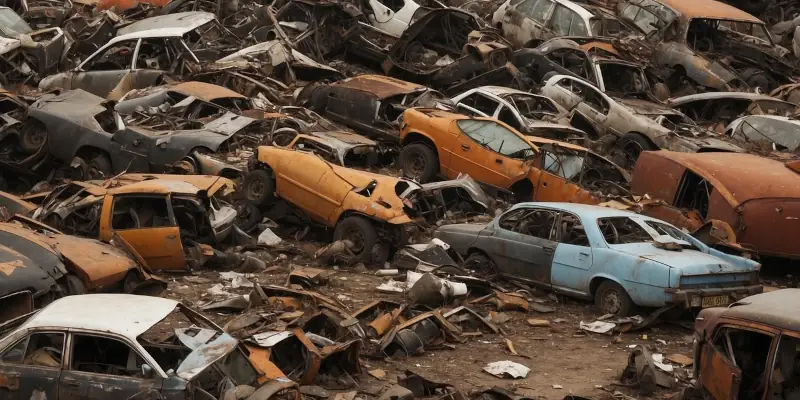
I saw on the news several days ago that illegal scavenging from garbage is increasing. That showed me that the economic phase is shifting steadily. Let’s discuss it.
What does the news mean?
Sometimes, we want to know the meaning of the news. That allows us to prepare and invest, which enriches us.
However, we sometimes don’t know how to make use of the news.

Today, I will show you an example of how to apply news topics to our investing theory. From my perspective, the economic trend seems to be shifting from the innovative industry to the resource industry. This perspective may help you verify your investing theory with the news.
A cycle of economic booms
There is a recurring cycle in economic booms, as I have mentioned many times in this blog. They occur in the following order of tending industries:
- The resource industries: They collect and provide the most fundamental resources, such as food, energy, water, metals, and other basic material resources.
- The fundamental processing industries: They use the above material resources and provide simple processed resources, such as agricultural product processors, oil refining companies, and steel companies.
- Advanced processing industries: They process simply processed materials and provide higher levels of services and products, such as food processing companies, restaurants, and heavy industries.
- Innovative equipment industries for the masses: They deliver technology-driven products and services to broader markets, boosting industrial efficiency. Examples are agricultural equipment companies and food processing facility companies.
- Innovative industries and research institutions: They provide the latest innovations. The current examples are AI development companies and a company that applied it.
- (Entering a recession and returning to the top)
We are now at the end of the innovative phase and the beginning of the resource phase.
The meaning of increasing scavenging
Applying that cycle enables us to understand the meaning of what is happening in the world.
The news of increasing illegal garbage scavenging, which I mentioned at the top of this article, doesn’t mean people’s morals have declined but that people have come to value resources more.
People always seek efficiency. Resources came to be sold at higher prices, so illegal scavenging organizations started collecting garbage. Although their actions go against the law and morals, an economic principle—people choose efficiency—drives them.

In other words, such scavenging is creating more social efficiency. Garbage placed at the collection site belongs to the city, but the city only buries or burns it. On the other hand, scavenging organizations recover usable materials and resell them. They add more value than the city. Although messing up and not cleaning the garbage dumps imposes additional costs on the city, and the overall efficiency is unclear, it is a people’s natural reaction from an economic perspective.
An example of a used car makes it easier to understand. We can either throw it away or sell it. We can discard it for $0 at an official car dealer. A used car company said they would buy it for $100, while a car parts company offered $120. It means the parts company’s competence to deliver greater value to customers from a single used car.
As long as it is within the economic processing cycle, discovering ways to sell at a higher price brings efficiency to the economy. Buying cheap and selling high is a principle of contributing to the economy.
My current outlook
In my prediction, the resource prices will continue to rise, and companies that handle resources and recycling will continue to increase.
At a certain point, investors realize that basic livelihood resources are more important than innovation. That would be the end of the AI bubble, and that would cause the stock market collapse.
That would be one point that we can benefit from super-long-term investing.
Conclusion
That is why the economic trend seems to be shifting from the innovative industry to the resource industry.
There is a recurring cycle in economic booms. It tells us about the rise of resource necessities and the decline in innovative value.
This perspective may help you verify your investing theory with the news.
Thank you for reading this article. I hope to see you in the next one.