

Recently, I have been seeing news about international conflicts and disputes more often around the world. That made me consider how to predict the future reasonably. Let’s discuss it.
How to reduce anxiety for the future of society
Sometimes, we want to reduce our anxiety. Many unsettling events and news make us uneasy.
One example is social disconnections, including international conflicts. The loss of cooperation often leads to war.
People often predict, “If things continue like this, the future will be so much worse!” Those negative predictions based on recent past data seem logical and inevitable. That makes us anxious.

However, in my opinion, such predictions based on the recent changes are inappropriate for the current turbulent era. Rather, it is more reasonable to suppose that the future will unfold in unexpected directions.
That understanding will ease your anxiety and enable you to prepare for the future reasonably. Today, I will explain why.
Two types of periods
In my opinion, it is already pointless to try to predict the future based on recent changes. Rather, it is more appropriate to assume that the future may unfold in any direction.
In other words, prepare for the unexpected rather than imaginable anxieties. That perspective will calm you and allow you to decide reasonably.
There are two types of periods, as shown in the following image:
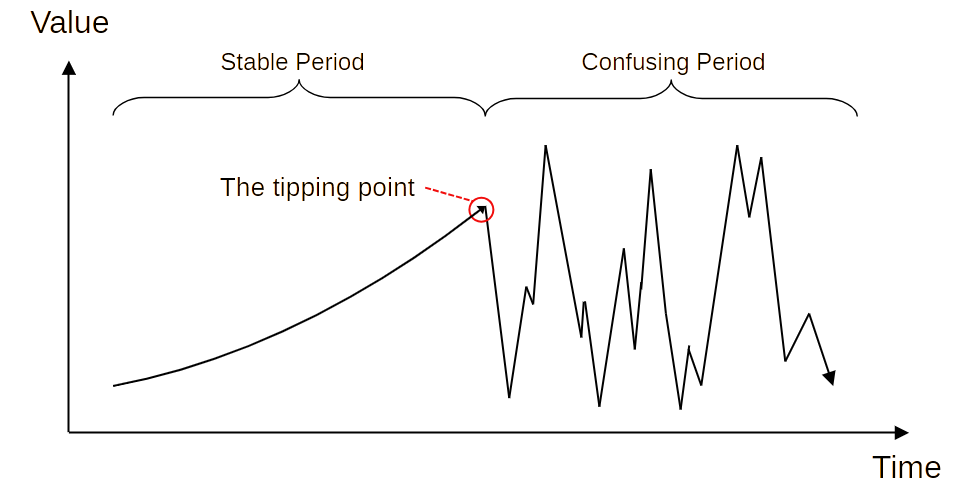
- A stable period: Since things shift continuously, we can predict the future based on recent past trends. People can plan more easily, so they tend not to make radical changes. During this period, the economy tends to boom.
- A confusing period: Since the situations can change suddenly, it is difficult to predict what will happen in the future. People cannot plan and are often driven by fear. That causes an extreme change in social direction. During this period, the economy tends to experience a recession.
In my opinion, we are currently at the tipping point—the beginning of a confusing period.
An example of driving a car
In this era, predicting based on recent past trends tends to be pointless.
To explain why, let’s look at an example of driving a car.
People are driving a car. The car is a community, like the government.
During a stable period, people don’t suddenly turn the steering wheel. Since they can run steadily and predict the future based on past changes, they tend to focus on speed and modify the direction gently.

As people experience this period for a long time, they come to think that it is natural to make judgments based on recent past trends.
Then, people gradually become dissatisfied with the limit of economic growth. That refuses gentle politics, and people choose a more radical leader. That causes sudden changes and starts a confusing period.
In a turbulent era, unexpected changes continuously occur. Many unexpected social disconnections happen, such as restricting trade and unnecessarily stirring up tensions with neighboring countries.
Fear makes them swerve sharply
However, people are still accustomed to the way of thinking during the stable period. They judge based on the recent drastic changes.
That scares them when they encounter a radical social change. They feel, “If the future unfolds like this, a fatal future awaits us.” In other words, they realize that there is a cliff in the direction of the car.
That makes them swerve sharply. If they were steering right, they would suddenly turn their wheel to the left.
However, there are also rivers and seas on the left side. They feel, “If we continue to go forward in this direction, the future will be like this! Our future is hopeless!”

People start to become confused. Some claim they should return to the original path. Some start to insist that they should cross the sea by car. Some come to fabricate unreasonable theories to push their point.
That is the state of the confusing era. We don’t know which way the car’s steering wheel will be turning tomorrow.
That is why sometimes longtime enemies suddenly reconcile with each other and face a new enemy together. The balance of power, allies, and enemies can change dramatically with a small trigger.
Conclusion
That is why it is now pointless to try to predict the future based on recent changes in a turbulent era.
Rather, it is more appropriate to assume that the future may unfold in any direction.
In other words, prepare for the unexpected rather than imaginable anxieties.
That understanding may ease your anxiety and enable you to prepare for the future reasonably.
Thank you for reading this article. I hope to see you in the next one.